.png)
The First 2,000 Days: The Science of Why the Years Before Six Matter Most (Early Childhood)

There is a number that quietly shapes your child's whole life, and most of us have never heard it.
It is about 2,000. That is roughly how many days there are from conception to the day a child turns five. Two thousand mornings. Two thousand chances to play, to be comforted, to ask why the sky changes colour. It sounds like a lot. It passes faster than any parent believes it will.
What science now tells us is that these 2,000 days are not simply a waiting room for "real" education. They are the most formative window of a human life. Almost everything that follows is built on the foundation laid here.
What we mean by the first 2,000 days
The phrase comes from public health, where it describes the window from conception to the day a child turns five. Count it out and you land at roughly 2,000 days. It has become a useful way to talk about something that is otherwise hard to feel at the moment: that the early years are not a soft prelude to school. They are the main event.
For parents in Singapore this matters even more. Children here start Primary 1 at six turning seven, which means every one of these 2,000 days is already behind your child before they sit in a formal classroom for the first time. The conversation about education tends to begin with P1. Science says it began long before. The most important learning your child will ever do is already happening, long before a single worksheet appears.
What is actually happening inside a young child's brain
In the first years of life, a child's brain builds itself at a pace it will never match again. Researchers at Harvard's Center on the Developing Child describe more than a million new neural connections forming every second in the earliest years. By the age of five, a child's brain has reached roughly ninety percent of its adult size.

Size, though, is only half the story. The other half is plasticity, the brain's ability to be reshaped by experience. Plasticity is at its highest in the earliest years and remains high through roughly the first eight. The sounds of language close early. Reasoning stays open longer. A young child's brain is not simply growing. It is unusually willing to be changed by whatever it meets.
This is why the same effort spent later rarely travels as far. A four year old absorbs a second language through play and conversation, almost without noticing. A fourteen year old can certainly learn that language, but it will take deliberate study, and the accent will probably stay. The same pattern holds for logical reasoning, for a musical ear, for the habits of attention. The material is the same. The brain's readiness to be shaped by it is not.
So why talk about 2,000 days rather than the roughly 3,200 that would take us to age eight? Because the first 2,000 days are when the foundation is poured, while plasticity is at its peak and the wiring for language, regulation and curiosity is forming fastest. The window does not slam shut on your child's fifth birthday. It stays generously open for years afterwards. But it is never again as wide as it is right now, and what we build in these days is what everything later stands on.
Think about what that means. Ninety percent of the architecture is in place before your child sits in a formal classroom. The wiring for language, for emotional regulation, for curiosity and focus and the ability to get along with others, most of it is laid down in these 2,000 days.

And here is the part that changes how we should parent and teach. That wiring is not built by drilling facts into a young child. It is built through relationships and experience. Scientists call it "serve and return." A baby babbles, a parent responds. A toddler points at a bird, an adult names it and wonders aloud where it is going. Each of these small exchanges is a brick in the foundation. Multiply them across 2,000 days and you have built a mind.
Why this quietly answers the question keeping parents up at night
Most parents we meet are carrying a version of the same worry. Is my child falling behind? Should they be reading already? Do we need more structure, more academics, more of the things that feel like school?
Science offers a gentler and more useful answer. In the first 2,000 days, the things that predict how well a child will thrive are not early academics. They are the capacities that early academics tend to crowd out: the ability to stay curious, to focus, to manage a big feeling without falling apart, to recover from frustration, to connect with other people.
A child who can calm themselves, pay attention, and keep asking questions will learn to read and count in good time. A child pushed into formal academics too early, at the cost of play and emotional security, often arrives at school able to perform but not always ready to thrive. The foundation matters more than the flourish.
This is not an argument against literacy and numeracy. It is an argument about sequence. Build the foundation first, and everything else has somewhere to stand.
What actually matters in these 2,000 days (early childhood)
If early academics are not the point, what is? The research keeps returning to a handful of things, and they are simpler and more human than the education market often admits.
Relationships come first. A child who feels safe and seen is a child whose brain is free to learn. Harvard researchers report that the single most common factor in children who develop resilience is at least one stable, committed relationship with a supportive adult.

Then language, in every form. Not flashcards, but conversation. The back and forth of being talked to, read to, listened to, and answered. The number of words and ideas a child swims in during these years shapes their thinking for decades.
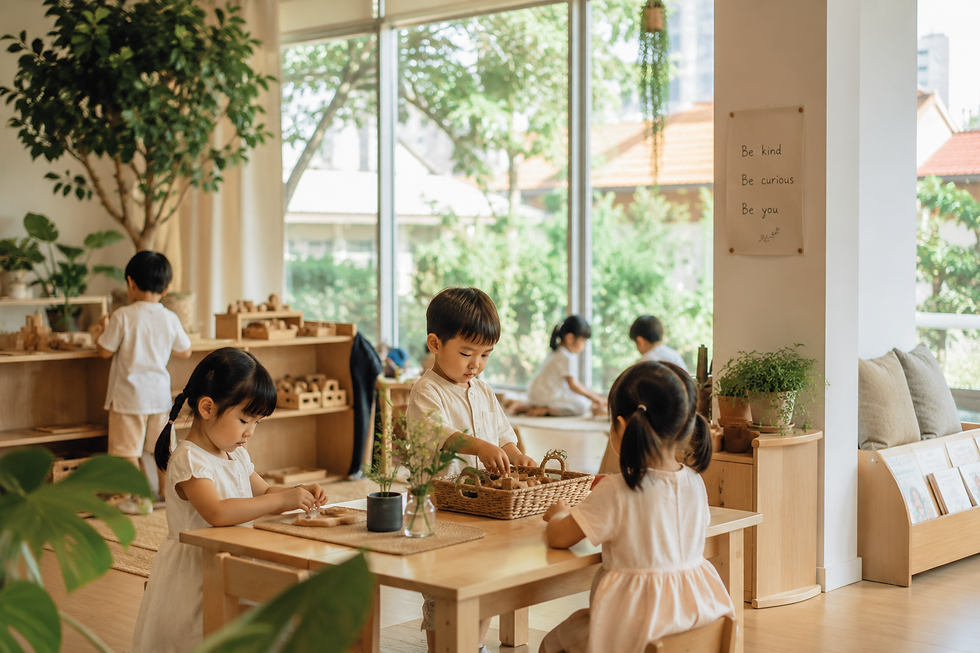
Then play, which is not the opposite of learning but the way young children do their most serious learning. When a child pours water between containers, negotiates a game, or builds and rebuilds a tower, they are running real experiments in physics, mathematics, language and social life.
Then emotional regulation, the quiet skill underneath all the others. A child who is learning to notice and settle their own feelings is building the self-control that focus, friendship and resilience all depend on.
And running through all of it, curiosity. The disposition to wonder, to ask, to try again. Protect a child's curiosity in these early childhood years and you protect their relationship with learning for life.
What this means for you, starting today
The good news is that none of this requires an expensive programme or a perfect parent. The most powerful things you can do in the first 2,000 days are also the most ordinary.
Talk with your child more than you talk to them. Narrate the day, ask real questions, and wait for the answer. Read together, every day if you can, long before they can read themselves. Let them be bored sometimes, because boredom is where imagination begins. Protect unhurried, screen-light play. And when the big feelings come, and they will, stay close and help your child name and ride the wave rather than rushing to switch it off.
None of this is complicated. All of it is quietly building a brain.
Where Amber fits
Everything we do at Amber is designed around this window. Our approach nurtures the whole child across mind, body and soul, precisely because the science says these years are where the whole foundation is laid. We treat emotional intelligence and life skills as part of the core curriculum, not an afterthought. We build calm, thoughtfully designed spaces where curiosity is invited and every child is noticed. We do this because the first 2,000 days only happen once, and we do not believe in wasting a single one of them.
Our educators also think carefully about how and when they introduce language, reasoning and problem solving, because when a brain is at its most adaptable, the quality of what we offer it matters enormously.

If you would like to see what learning through these years can look like, we would love to show you. Come and spend a Discovery Morning with us, watch your child explore our ateliers and learning spaces, and meet the educators who would walk these days alongside you.
The first 2,000 days pass quickly. Let us make them count, together.
Book a Discovery Morning at Amber. Email us at hello@amberinternational.co or register your interest at www,amberinternational.co.
Footnotes
We think parents deserve to see where our claims come from, so here they are.
Brain architecture, the million new neural connections formed every second, and serve and return: Harvard University, Center on the Developing Child. https://developingchild.harvard.edu/key-concept/brain-architecture/
Relationships and resilience: Harvard Center on the Developing Child, The Science of Resilience. https://developingchild.harvard.edu/resources/working-paper/supportive-relationships-and-active-skill-building-strengthen-the-foundations-of-resilience/
The first 2,000 days, defined as conception to a fifth birthday: The Australian Prevention Partnership Centre. https://preventioncentre.org.au/resources/the-first-2000-days-giving-kids-best-start/
On plasticity, the research is clear that the brain is most adaptable in the earliest years and remains highly plastic through roughly the first eight. It is equally clear that sensitive periods differ by skill, which is why we have been careful not to promise a single closing date.

Comments