.png)
The Parent's Guide to Choosing a Preschool in Katong and the East Coast (2026)

Updated: Jun 30
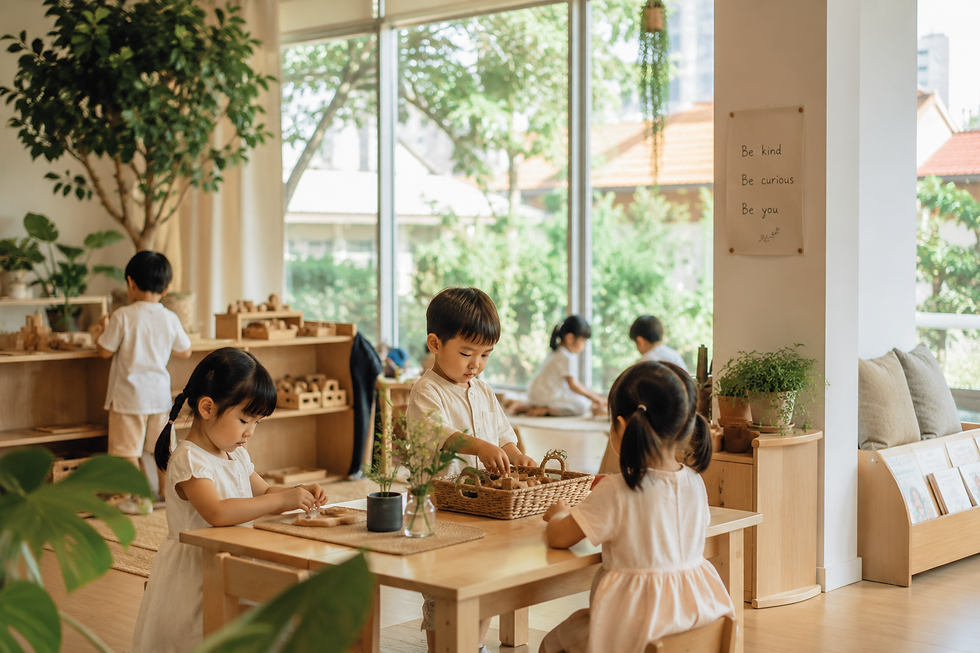
If you live in Katong, Joo Chiat, Marine Parade or along the East Coast, you are spoilt for choice. Within a few streets you will find Montessori houses, premium chains, neighbourhood childcare centres, and a handful of schools doing something quieter and more intentional. That abundance is a gift. It can also be overwhelming, especially when every school's website promises much the same thing.
This guide is written to help you choose well, not quickly. We have tried to be honest about the trade-offs, because the right preschool is the one that fits your child and your family. Hopefully with this, you can decide the right preschool in the Katong and East Coast area.
Start with your child, not the school
Before you compare curricula, spend a moment with a simpler question. How does your child meet the world? Some children are cautious and observant, and they settle best in calm, predictable spaces with educators who move slowly. Others are physical and social, and they need room to run, build, and negotiate with other children. A school that suits one temperament can quietly overwhelm another.
There is no universally best approach. There is only the approach that lets your particular child feel safe enough to try, and curious enough to keep going.
Understand the curriculum styles
In Singapore you will mostly encounter four philosophies, often blended.
Montessori offers structured independence, with carefully prepared materials children choose for themselves. Reggio Emilia and inquiry-based learning follow the child's curiosity, using projects and provocations rather than worksheets. Play-based learning treats play as serious work, building skills through exploration. Different programmes may approach literacy and numeracy differently. Some introduce skills through more structured lessons, while others integrate them into projects, play, and inquiry experiences.
If those terms feel slippery, you are not alone. We have written a plain-English comparison to help, and a separate piece on what inquiry-based learning actually looks like day to day. Both are linked at the end.
Know the local landscape
The East Coast and Katong are home to a wide range of schools, from heritage Montessori houses to premium preschool chains and warm neighbourhood centres. Fees in the area span a broad range, with private and premium preschools in Singapore generally sitting between roughly $1,000 and $2,500 a month in 2026, and some premium players higher.
Government-supported and Anchor Operator centres are considerably more affordable, with childcare fees capped at $610 from January 2026.
What this means in practice is that price alone tells you very little. Two schools at similar fees can offer profoundly different daily experiences. The question worth asking is not only what does it cost, but what is my child actually doing for ten hours a day, and who is beside them while they do it.
What to look for on a tour
A website cannot show you the things that matter most. When you visit, notice the sound of the room. Is it frantic or calm? Watch how an educator speaks to a child who is upset. Look at the work on the walls. Is it twenty identical crafts, or twenty different attempts at the same idea? Rather than looking only at the final product, parents should consider the learning process and the conversations that took place during the experience.
Ask how the school handles settling in and separation anxiety. Ask how they support a child who is dysregulated. Ask what a typical day looks like, then listen for whether play and rest have a real place in it, or whether the day is a series of timetabled drills.
A short checklist before you decide
Consider proximity to home or work, because a long commute wears on a small child. Consider the educator-to-child ratio, as meaningful because interactions between educators and children are one of the most important factors influencing learning and development. Consider whether the environment feels designed for children or simply decorated for parents. Consider how the school approaches your priorities, whether that is bilingualism, inclusion, outdoor time, or a gentle, unhurried pace.
And consider how you feel when you leave. Parents often know within the first ten minutes of a tour. Trust that.
A note on how we think about this at Amber
Amber sits in the heart of Katong, at Eastgate. We are an inquiry-based, inclusive, bilingual preschool, and we built our spaces to be calm and sensory-smart on purpose, because a child who feels safe is a child who can learn.
We would rather a child leave us curious and kind than merely able to recite. If that resonates, we would love to show you around in person.
Book a private tour at Amber Katong, or join our mailing list. You are welcome to come and simply watch a morning unfold.


Comments